














Rare Old Map Indian Territory in Texas & New Mexico by Gregg, 1844: US-Mexico Border, Rio Grande, San Antonio, El Paso, New Mexico
Restaurée dans notre atelier londonien à partir de la carte originale de 1874 et imprimée en qualité musée. Description complète
L’offre du collectionneur
Choisissez deux œuvres éligibles et bénéficiez de 20 % de réduction sur les deux. Choisissez-en trois et celle au prix le plus bas est offerte, pour une économie maximale de 33 %.
Associez librement des cartes standard éligibles et des tirages d’art. Aucun code n’est requis ; l’offre est appliquée automatiquement lors du paiement.
Les configurations standard réalisées sur commande sont incluses. Les formats sur mesure, les créations personnalisées et les œuvres commissionnées sont exclus.
Besoin d’une livraison à différentes adresses ? Contactez-nous avant de commander.L’offre du collectionneur
Choisissez deux œuvres éligibles et bénéficiez de 20 % de réduction sur les deux. Choisissez-en trois et celle au prix le plus bas est offerte, pour une économie maximale de 33 %.
Associez librement des cartes standard éligibles et des tirages d’art. Aucun code n’est requis ; l’offre est appliquée automatiquement lors du paiement.
Les configurations standard réalisées sur commande sont incluses. Les formats sur mesure, les créations personnalisées et les œuvres commissionnées sont exclus.
Besoin d’une livraison à différentes adresses ? Contactez-nous avant de commander. Restauré à Londres • Imprimé et encadré en the USA

Restaurée à partir de la carte originale de 1874 et imprimée en qualité musée. Description complète
Choisissez votre format
Choisissez votre finition


(Plus d’infos)
Message cadeau & finition personnalisée

Si vous souhaitez ajouter un message cadeau, ou une finition (puzzle, panneau en aluminium, etc.) qui n'est pas disponible ici, veuillez le demander dans la "note de commande" lors de votre passage à la caisse.
Chaque commande est fabriquée sur mesure, donc si vous avez besoin d'ajuster légèrement la taille, ou d'imprimer sur un matériau inhabituel, faites-le nous savoir. Nous avons réalisé des milliers de commandes personnalisées au fil des ans, donc il n'y a (presque) rien que nous ne puissions gérer.
Vous pouvez également nous contacter avant de passer votre commande, si vous le souhaitez !
- Fabriqué en the USA. Livraison sûre
- Arrive en parfait état, sinon nous le remplaçons
- Livraison le lendemain disponible
- Besoin d’aide pour commander ? Appeler, envoyer un SMS ou WhatsApp
Faites entrer un morceau d’histoire chez vous
Plus de 8 000 avis 5 étoiles


A Map of the Indian Territory Northern Texas and New Mexico Showing the Great Western Prairies distills the restless expanse of the...
Continuer la lectureA Map of the Indian Territory Northern Texas and New Mexico Showing the Great Western Prairies distills the restless expanse of the mid-19th-century borderlands into a lucid, field-informed picture. Created in 1844 by Josiah Gregg and issued by Sidney E. Morse and Samuel Breese under entry of the Act of Congress, it frames the Rio Grande as a commanding axis and political divide, while clear border lines and maize-toned shading articulate shifting sovereignties. A battery of symbols locates towns, villages, ranches, forts, trading posts, camps, springs, and ruins; elevation lines model the rise and fall of prairie and mesa. Anchoring the human geography are San Antonio, Dallas, Fort Worth, and El Paso on the U.S. side, paired with Ciudad Juárez (then El Paso del Norte), a twinned gateway binding two nations across the river.
Gregg, a merchant-naturalist and veteran of the Santa Fe trade, was uniquely positioned to capture this region at the confluence of commerce, culture, and topography. His overland caravans yielded meticulous notes on routes, fords, and encampments—practical intelligence he refined in print and on this map. The result fuses traveler’s pragmatism with scholar’s care: mountain relief rendered by careful linework, watercourses traced with a surveyor’s economy, and settlements calibrated to the lived geography of supply and security. The imprint of Morse and Breese—pioneers in precise American cartographic publishing—ensures a crisp, intelligible symbology and a distribution that placed Gregg’s hard-won observations before a national audience hungry for western knowledge.
Foremost among the map’s virtues is its ethnographic literacy. Gregg notes Native American residence patterns with a candor that acknowledges mobility and disruption—villages, seasonal camps, and ranges marked where prairies meet river corridors and springs. These notations register a moment when forced relocations and treaty lines were accelerating change, a process that intensified after 1848. Indian Territory appears not as blank space but as a mosaic of peoples whose movements shaped trade, diplomacy, and conflict. Trading posts and forts punctuate contact zones, while named springs and fords—lifelines in an arid country—chart the itineraries of hunters, herders, and caravans threading between the Red River watershed, the plains, and the Rio Grande valley.
The cartography clarifies how landscape channeled history. The Rio Grande, running like a braided seam, asserts the U.S.–Mexico boundary even as roads and ranches stitch across it. Elevation lines and careful shading lift plateaus and breaks from the page, showing why forts cluster along defensible ground and why ranches spread where water and grass converge. Labels guide the eye from San Antonio north and west through prairie corridors to Dallas and Fort Worth, and onward across the wild spaces toward El Paso and Ciudad Juárez. Waypoints—camps, springs, ruins—transform abstraction into itinerary, revealing how travelers navigated risk and scarcity along routes that were as strategic as they were commercial.
Historically, the map reads as both diagnosis and forecast. It captures a volatile frontier where cattle theft, cross-border raiding, and improvised justice coexisted with legal frameworks only fitfully enforced. Clear territorial lines hint at order; the dense overlay of forts, posts, and encampments reveals the contested reality beneath. As the Mexican–American War redrew claims and accelerated migration, Gregg’s prairie atlas became an indispensable key to interpreting sovereignty on the move—who lived where, who traded with whom, and along which rivers and roads power actually flowed. For the connoisseur, it offers rare, firsthand coherence amid the 19th-century tumult: a disciplined map that still breathes with dust, distance, and decision.
Cities and towns on this map
- Fort Worth, Texas
- Dallas, Texas
- San Antonio, Texas
- El Paso, Texas
- Ciudad Juárez (formerly El Paso del Norte)
- Other lesser-known settlements, primarily smaller communities, indicated with symbols but not named specifically.
Notable Features & Landmarks
- Borders of territories, represented by clear lines and labels.
- Symbols indicating towns, villages, ranches, forts, trading posts, camps, springs, and ruins.
- Major rivers including the Rio Grande, with the river prominently marking the U.S.-Mexico boundary.
- Elevation lines indicating the physical geography of the area.
- Labels indicating key locations and landmarks significant to travelers and settlers of the time.
Historical and design context
- Josiah Gregg, created in 1844; published by Sidney E. Morse and Samuel Breese, entered according to Act of Congress.
- Josiah Gregg was notable for his exploration and writings about the American West, contributing essential knowledge about this region during its formative years.
- The map shows residence patterns of Native Americans, particularly post-1848 relocations to U.S. territories.
- Highlights settlement patterns of this time period, reflecting upon the sociopolitical landscape between Texas and Mexico, including issues of lawlessness, cattle theft, and Native American interactions.
- Covers regions of Northern Texas and New Mexico, particularly highlighting areas around the Rio Grande.
- Features original maize shading at the borders, employing a detailed cartographic style with various symbols representing towns, ranches, and notable geographical elements.
- Reflects tensions in the borderlands of the U.S. and Mexico during the 19th century.
- It's a significant resource for understanding the complexity of territorial claims and cultural interactions in this transitional period.
Please double check the images to make sure that a specific town or place is shown on this map. You can also get in touch and ask us to check the map for you.
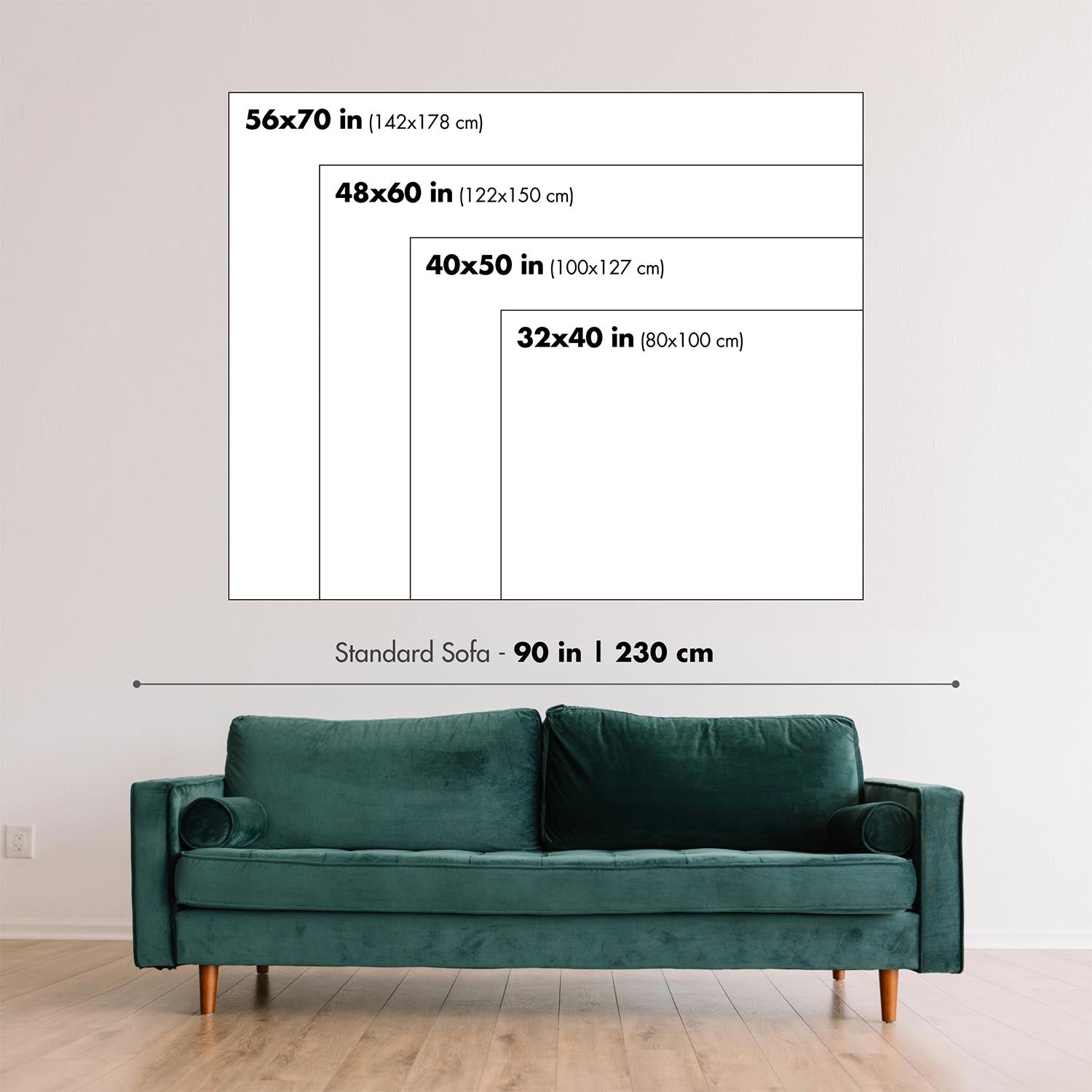
This map looks great at every size, but I always recommend going for a larger size if you have space. That way you can easily make out all of the details.
This map looks amazing at sizes all the way up to 50in (125cm). If you are looking for a larger map, please get in touch.
The model in the listing images is holding the 20x16in (50x40cm) version of this map.
The fifth listing image shows an example of my map personalisation service.
If you’re looking for something slightly different, check out my collection of the best old maps to see if something else catches your eye.
Please contact me to check if a certain location, landmark or feature is shown on this map.
This would make a wonderful birthday, Christmas, Father's Day, work leaving, anniversary or housewarming gift for someone from the areas covered by this map.
This map is available as a giclée print on acid free archival matte paper, or you can buy it framed. The frame is a nice, simple black frame that suits most aesthetics. Please get in touch if you'd like a different frame colour or material. My frames are glazed with super-clear museum-grade acrylic (perspex/acrylite), which is significantly less reflective than glass, safer, and will always arrive in perfect condition.
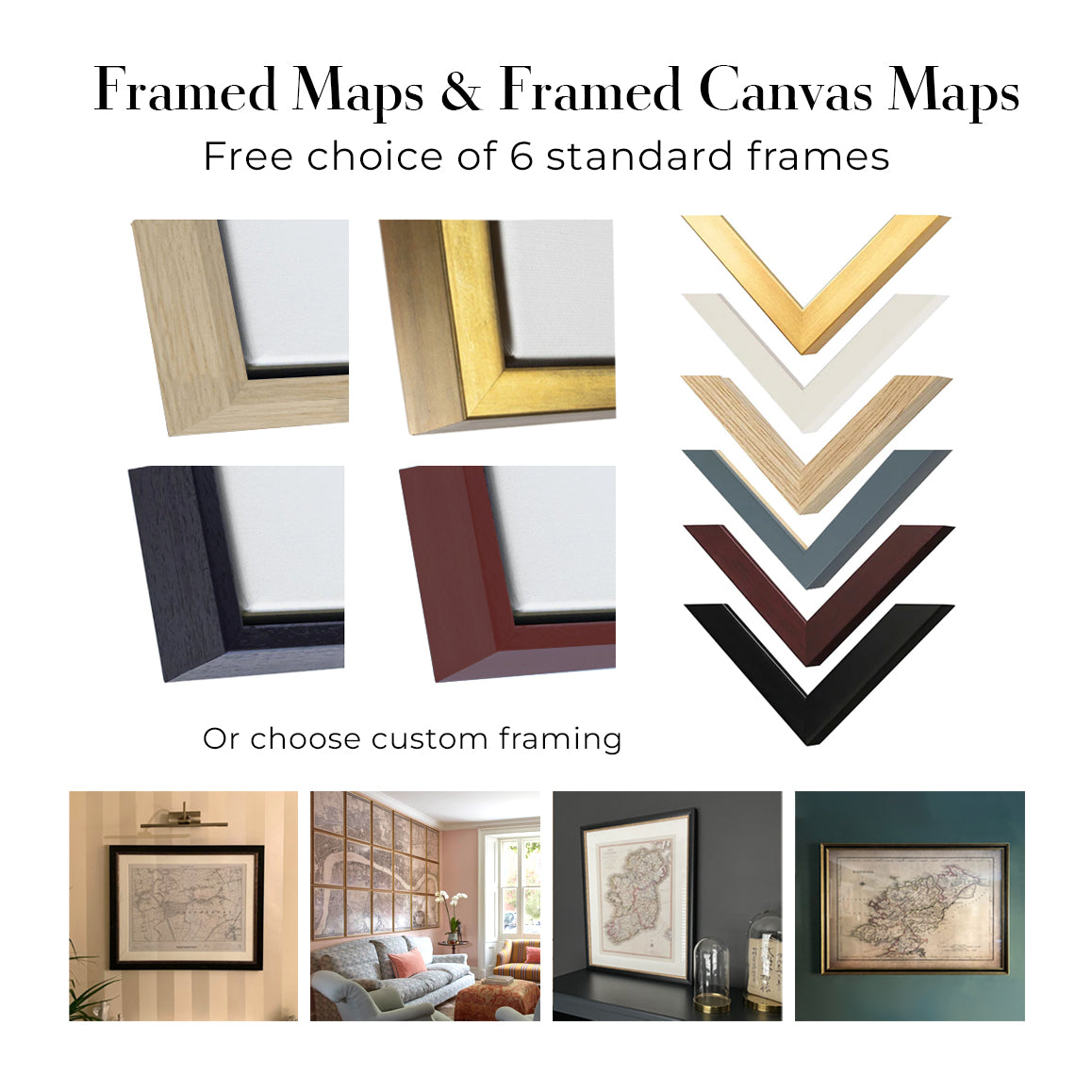
This map is also available as a float framed canvas, sometimes known as a shadow gap framed canvas or canvas floater. The map is printed on artist's cotton canvas and then stretched over a handmade box frame. We then "float" the canvas inside a wooden frame, which is available in a range of colours (black, dark brown, oak, antique gold and white). This is a wonderful way to present a map without glazing in front. See some examples of float framed canvas maps and explore the differences between my different finishes.
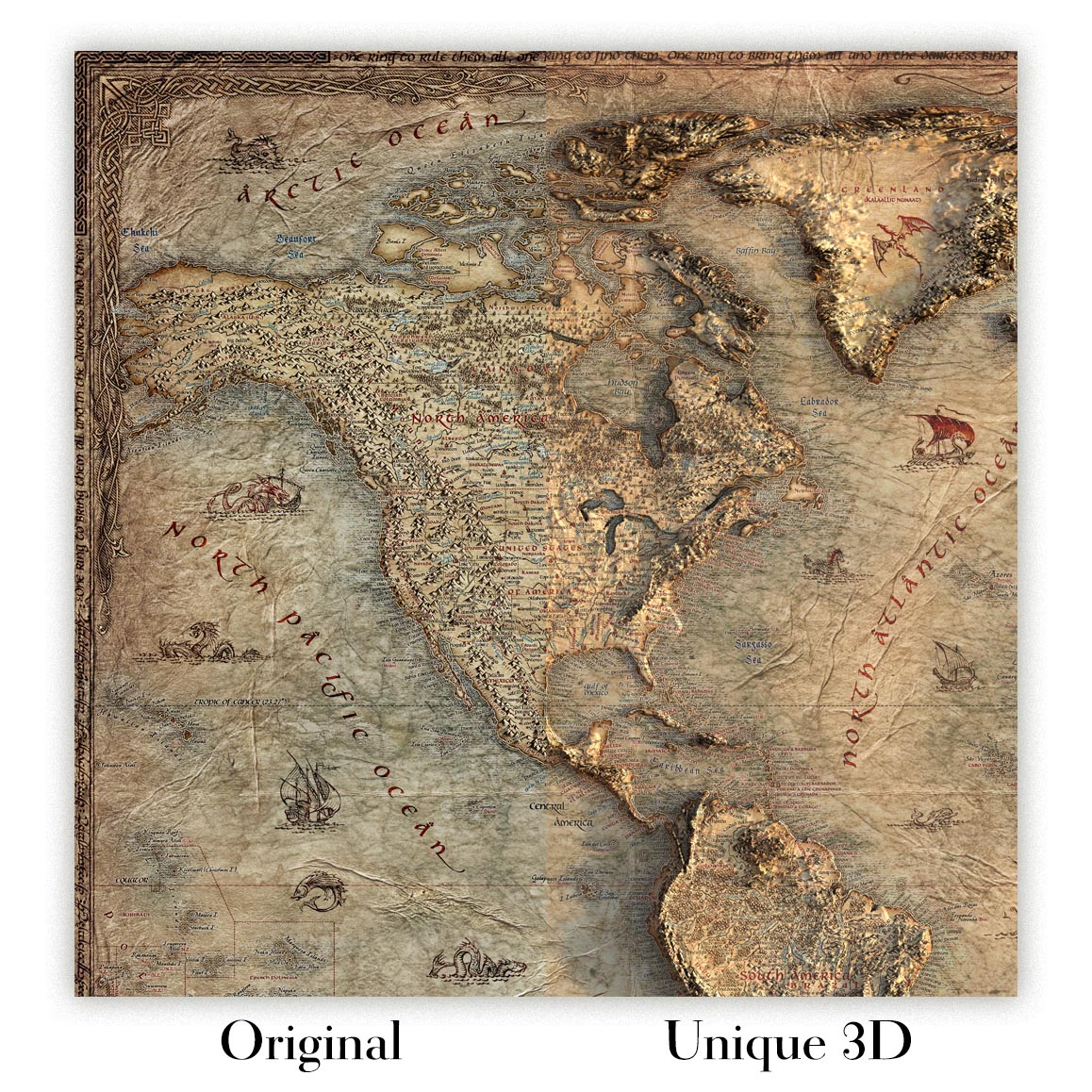
For something truly unique, this map is also available in "Unique 3D", our trademarked process that dramatically transforms the map so that it has a wonderful sense of depth. We combine the original map with detailed topography and elevation data, so that mountains and the terrain really "pop". For more info and examples of 3D maps, check my Unique 3D page.
A Map of the Indian Territory Northern Texas and New Mexico Showing the Great Western Prairies distills the restless expanse of the mid-19th-century borderlands into a lucid, field-informed picture. Created in 1844 by Josiah Gregg and issued by Sidney E. Morse and Samuel Breese under entry of the Act of Congress, it frames the Rio Grande as a commanding axis and political divide, while clear border lines and maize-toned shading articulate shifting sovereignties. A battery of symbols locates towns, villages, ranches, forts, trading posts, camps, springs, and ruins; elevation lines model the rise and fall of prairie and mesa. Anchoring the human geography are San Antonio, Dallas, Fort Worth, and El Paso on the U.S. side, paired with Ciudad Juárez (then El Paso del Norte), a twinned gateway binding two nations across the river.
Gregg, a merchant-naturalist and veteran of the Santa Fe trade, was uniquely positioned to capture this region at the confluence of commerce, culture, and topography. His overland caravans yielded meticulous notes on routes, fords, and encampments—practical intelligence he refined in print and on this map. The result fuses traveler’s pragmatism with scholar’s care: mountain relief rendered by careful linework, watercourses traced with a surveyor’s economy, and settlements calibrated to the lived geography of supply and security. The imprint of Morse and Breese—pioneers in precise American cartographic publishing—ensures a crisp, intelligible symbology and a distribution that placed Gregg’s hard-won observations before a national audience hungry for western knowledge.
Foremost among the map’s virtues is its ethnographic literacy. Gregg notes Native American residence patterns with a candor that acknowledges mobility and disruption—villages, seasonal camps, and ranges marked where prairies meet river corridors and springs. These notations register a moment when forced relocations and treaty lines were accelerating change, a process that intensified after 1848. Indian Territory appears not as blank space but as a mosaic of peoples whose movements shaped trade, diplomacy, and conflict. Trading posts and forts punctuate contact zones, while named springs and fords—lifelines in an arid country—chart the itineraries of hunters, herders, and caravans threading between the Red River watershed, the plains, and the Rio Grande valley.
The cartography clarifies how landscape channeled history. The Rio Grande, running like a braided seam, asserts the U.S.–Mexico boundary even as roads and ranches stitch across it. Elevation lines and careful shading lift plateaus and breaks from the page, showing why forts cluster along defensible ground and why ranches spread where water and grass converge. Labels guide the eye from San Antonio north and west through prairie corridors to Dallas and Fort Worth, and onward across the wild spaces toward El Paso and Ciudad Juárez. Waypoints—camps, springs, ruins—transform abstraction into itinerary, revealing how travelers navigated risk and scarcity along routes that were as strategic as they were commercial.
Historically, the map reads as both diagnosis and forecast. It captures a volatile frontier where cattle theft, cross-border raiding, and improvised justice coexisted with legal frameworks only fitfully enforced. Clear territorial lines hint at order; the dense overlay of forts, posts, and encampments reveals the contested reality beneath. As the Mexican–American War redrew claims and accelerated migration, Gregg’s prairie atlas became an indispensable key to interpreting sovereignty on the move—who lived where, who traded with whom, and along which rivers and roads power actually flowed. For the connoisseur, it offers rare, firsthand coherence amid the 19th-century tumult: a disciplined map that still breathes with dust, distance, and decision.
Cities and towns on this map
- Fort Worth, Texas
- Dallas, Texas
- San Antonio, Texas
- El Paso, Texas
- Ciudad Juárez (formerly El Paso del Norte)
- Other lesser-known settlements, primarily smaller communities, indicated with symbols but not named specifically.
Notable Features & Landmarks
- Borders of territories, represented by clear lines and labels.
- Symbols indicating towns, villages, ranches, forts, trading posts, camps, springs, and ruins.
- Major rivers including the Rio Grande, with the river prominently marking the U.S.-Mexico boundary.
- Elevation lines indicating the physical geography of the area.
- Labels indicating key locations and landmarks significant to travelers and settlers of the time.
Historical and design context
- Josiah Gregg, created in 1844; published by Sidney E. Morse and Samuel Breese, entered according to Act of Congress.
- Josiah Gregg was notable for his exploration and writings about the American West, contributing essential knowledge about this region during its formative years.
- The map shows residence patterns of Native Americans, particularly post-1848 relocations to U.S. territories.
- Highlights settlement patterns of this time period, reflecting upon the sociopolitical landscape between Texas and Mexico, including issues of lawlessness, cattle theft, and Native American interactions.
- Covers regions of Northern Texas and New Mexico, particularly highlighting areas around the Rio Grande.
- Features original maize shading at the borders, employing a detailed cartographic style with various symbols representing towns, ranches, and notable geographical elements.
- Reflects tensions in the borderlands of the U.S. and Mexico during the 19th century.
- It's a significant resource for understanding the complexity of territorial claims and cultural interactions in this transitional period.
Please double check the images to make sure that a specific town or place is shown on this map. You can also get in touch and ask us to check the map for you.
This map looks great at every size, but I always recommend going for a larger size if you have space. That way you can easily make out all of the details.
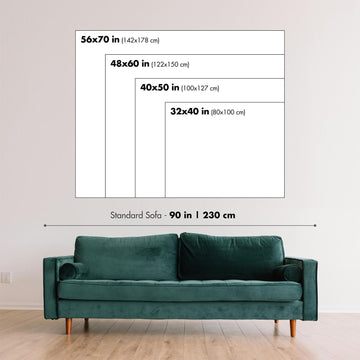
This map looks amazing at sizes all the way up to 50in (125cm). If you are looking for a larger map, please get in touch.
The model in the listing images is holding the 20x16in (50x40cm) version of this map.
The fifth listing image shows an example of my map personalisation service.
If you’re looking for something slightly different, check out my collection of the best old maps to see if something else catches your eye.
Please contact me to check if a certain location, landmark or feature is shown on this map.
This would make a wonderful birthday, Christmas, Father's Day, work leaving, anniversary or housewarming gift for someone from the areas covered by this map.
This map is available as a giclée print on acid free archival matte paper, or you can buy it framed. The frame is a nice, simple black frame that suits most aesthetics. Please get in touch if you'd like a different frame colour or material. My frames are glazed with super-clear museum-grade acrylic (perspex/acrylite), which is significantly less reflective than glass, safer, and will always arrive in perfect condition.
This map is also available as a float framed canvas, sometimes known as a shadow gap framed canvas or canvas floater. The map is printed on artist's cotton canvas and then stretched over a handmade box frame. We then "float" the canvas inside a wooden frame, which is available in a range of colours (black, dark brown, oak, antique gold and white). This is a wonderful way to present a map without glazing in front. See some examples of float framed canvas maps and explore the differences between my different finishes.
For something truly unique, this map is also available in "Unique 3D", our trademarked process that dramatically transforms the map so that it has a wonderful sense of depth. We combine the original map with detailed topography and elevation data, so that mountains and the terrain really "pop". For more info and examples of 3D maps, check my Unique 3D page.
Nombre de nos cartes et tirages d’art sont choisis comme cadeaux attentionnés pour des intérieurs, des bureaux, des cabinets de travail et des lieux chargés de sens.
Choisissez une option encadrée pour un cadeau prêt à être accroché en toute simplicité, ou optez pour un tirage non encadré si le destinataire préfère peut-être sélectionner son propre cadre.
Nous fabriquons les commandes localement dans 23 pays à travers le monde, afin que les cadeaux puissent souvent être produits à proximité du destinataire. Cela permet une livraison plus rapide, un transport plus sûr et d’éviter les surprises liées aux frais de douane ou droits d’importation.
- Nous pouvons livrer directement au destinataire
- Les pièces encadrées arrivent prêtes à être accrochées
- Les tirages non encadrés sont soigneusement emballés dans un tube de protection robuste
- Presque chaque commande est fabriquée localement, pour des cadeaux plus rapides et plus sûrs
- Les retours sous 90 jours laissent au destinataire le temps de se décider
Si vous hésitez sur le choix à faire, veuillez nous contacter. Nous pouvons vous aider à choisir la carte, le format, la finition ou l’option de livraison appropriés.
Pour la plupart des commandes, le délai de livraison est d'environ 3 jours ouvrables. Les produits personnalisés et sur mesure prennent plus de temps, car je dois faire la personnalisation et vous l'envoyer pour approbation, ce qui prend généralement 1 ou 2 jours.
Veuillez noter que les grandes commandes encadrées prennent généralement plus de temps à réaliser et à livrer.
Si vous avez besoin que votre commande arrive à une date précise, veuillez me contacter avant de passer votre commande afin que nous puissions trouver le meilleur moyen de nous assurer que vous receviez votre commande à temps.
J'imprime et encadre des cartes et des œuvres d'art dans 23 pays à travers le monde. Cela signifie que votre commande sera réalisée localement, ce qui réduit le temps de livraison et garantit qu'elle ne sera pas endommagée pendant le transport. Vous ne paierez jamais de droits de douane ou d'importation, et nous mettrons moins de CO2 dans l'air.
Toutes mes cartes et impressions artistiques sont bien emballées et envoyées dans un tube robuste si non encadrées, ou entourées de mousse si encadrées.
J'essaie d'envoyer toutes les commandes dans les 1 ou 2 jours suivant la réception de votre commande, bien que certains produits (comme les masques, les mugs et les sacs fourre-tout) puissent prendre plus de temps à réaliser.
Si vous choisissez Livraison Express lors du paiement, nous donnerons la priorité à votre commande et l'enverrons par un service de messagerie de 1 jour (Fedex, DHL, UPS, Parcelforce).
La livraison le lendemain est également disponible dans certains pays (États-Unis, Royaume-Uni, Singapour, Émirats Arabes Unis), mais veuillez essayer de commander tôt dans la journée afin que nous puissions l'envoyer à temps.
Lisez mon guide complet sur la livraison et la production locale
Mon cadre standard est un cadre en bois dur noir de style galerie. Il est simple et a un aspect assez moderne. Mon cadre standard mesure environ 20 mm (0,8 po) de large.
J'utilise de l'acrylique super clair (perspex/acrylite) pour le verre du cadre. C'est plus léger et plus sûr que le verre - et cela a meilleur aspect, car la réflexivité est plus faible.
Six couleurs de cadre standard sont disponibles gratuitement (noir, marron foncé, gris foncé, chêne, blanc et or antique). Des encadrements et montages/matelassages personnalisés sont disponibles si vous recherchez autre chose.
La plupart des cartes, œuvres d'art et illustrations sont également disponibles sous forme de toile encadrée. Nous utilisons une toile en coton mate (non brillante), que nous tendons sur un cadre en bois de boîte provenant de sources durables, puis nous 'flottions' la pièce à l'intérieur d'un cadre en bois. Le résultat final est assez beau, et il n'y a pas de vitrage qui gêne.
Tous les cadres sont fournis "prêts à accrocher", avec soit une corde, soit des supports à l'arrière. Les très grands cadres auront des plaques de suspension lourdes et/ou une latte de montage. Si vous avez des questions, veuillez nous contacter.
Voir quelques exemples de mes cartes encadrées et de cartes en toile encadrées.
Alternativement, je peux également fournir de vieilles cartes et œuvres d'art sur toile, sur panneau en mousse, en coton et d'autres matériaux.
Si vous souhaitez encadrer votre carte ou œuvre d'art vous-même, veuillez lire d'abord mon guide des tailles.
Nous travaillons avec des architectes d’intérieur, des acteurs de l’hôtellerie, des professionnels de l’immobilier, des bureaux et des acheteurs corporate, pour des pièces individuelles comme pour des projets coordonnés de plus grande envergure.
Cette carte peut être adaptée à un mur, une pièce ou un projet particulier, et notre atelier peut vous aider à coordonner les dimensions, le matériau et l’encadrement avant la production.
- Dimensions exactes, hors format et sur mesure
- Encadrement, montage et matériaux alternatifs sur mesure
- Pièces coordonnées pour plusieurs pièces ou sites
- Personnalisation de la carte, pour marquer des lieux importants ou ajouter des détails supplémentaires
- Conseils sur la carte et l’encadrement par notre atelier
- Production locale pour des projets dans le monde entier
Échangez au sujet de cette pièce avec notre équipe Trade & Projects
Mes cartes sont des reproductions de cartes originales de très haute qualité.
Je recherche des cartes originales et rares auprès de bibliothèques, de maisons de ventes aux enchères et de collections privées du monde entier, je les restaure dans mon atelier de Londres, puis j'utilise des encres et des imprimantes giclées spécialisées pour créer de magnifiques cartes encore plus belles que l'originale.
Mes cartes sont imprimées sur du papier d’archives mat (non brillant) sans acide qui semble de très haute qualité et ressemble presque à une carte. En termes techniques, le grammage/épaisseur du papier est de 10 mil/200 g/m². C'est parfait pour l'encadrement.
J’imprime avec des encres pigmentaires Epson ultrachrome giclée UV résistantes à la décoloration – certaines des meilleures encres que vous puissiez trouver.
je peux aussi faire cartes sur toile, chiffon en coton et autres matériaux exotiques.
En savoir plus sur Unique Maps Co..
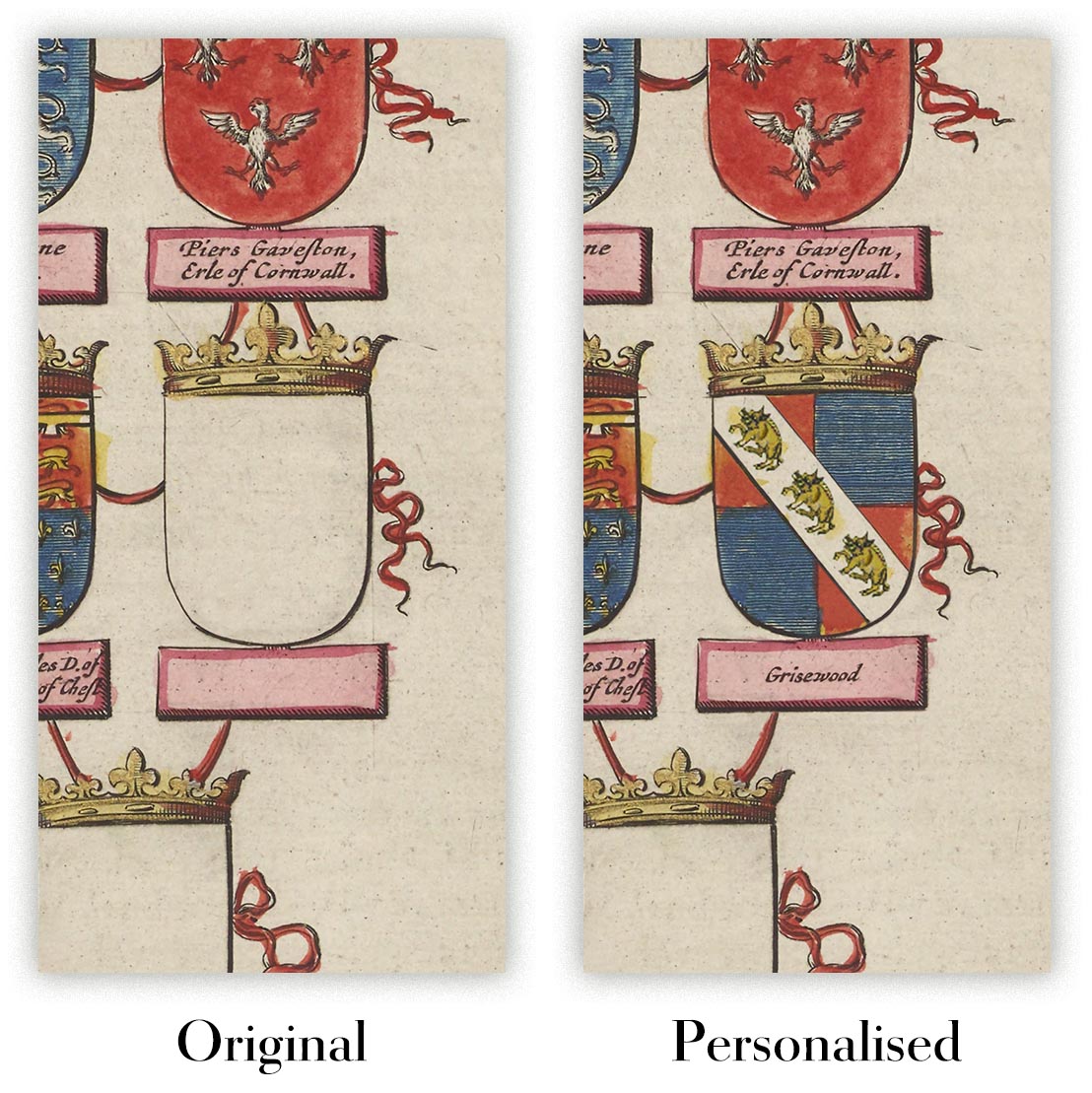
Personnalisation de la carte
Si vous recherchez le cadeau parfait pour un anniversaire ou une pendaison de crémaillère, je peux personnaliser votre carte pour la rendre vraiment unique. Par exemple, je peux ajouter un court message, mettre en évidence un lieu important ou ajouter les armoiries de votre famille.
Les options sont presque infinies. S'il vous plaît voir mon page de personnalisation de la carte pour quelques merveilleux exemples de ce qui est possible.
Pour commander une carte personnalisée, sélectionnez « personnaliser votre carte » avant de l'ajouter à votre panier.
Entrer en contact si vous recherchez des personnalisations et des personnalisations plus complexes.
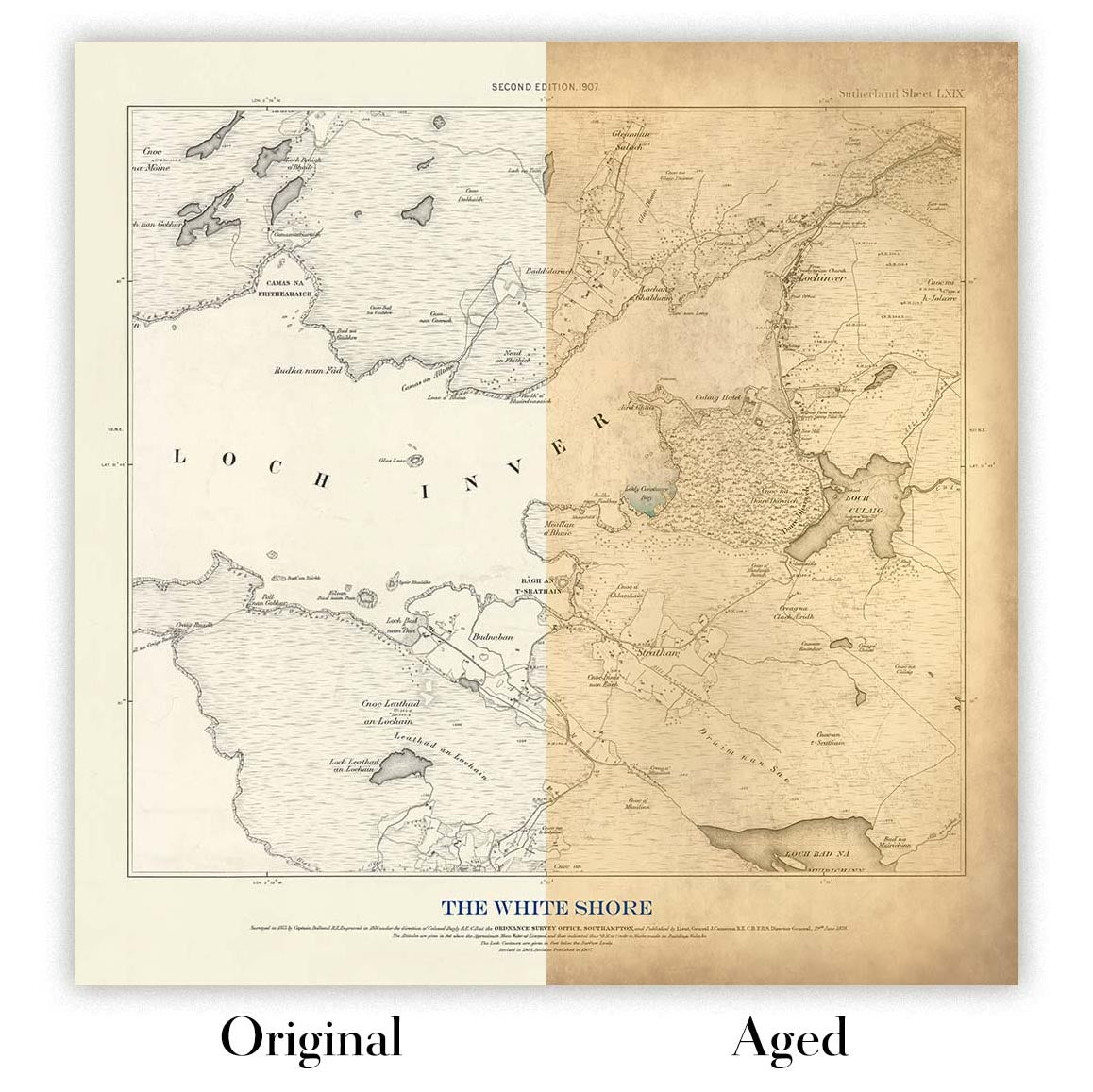
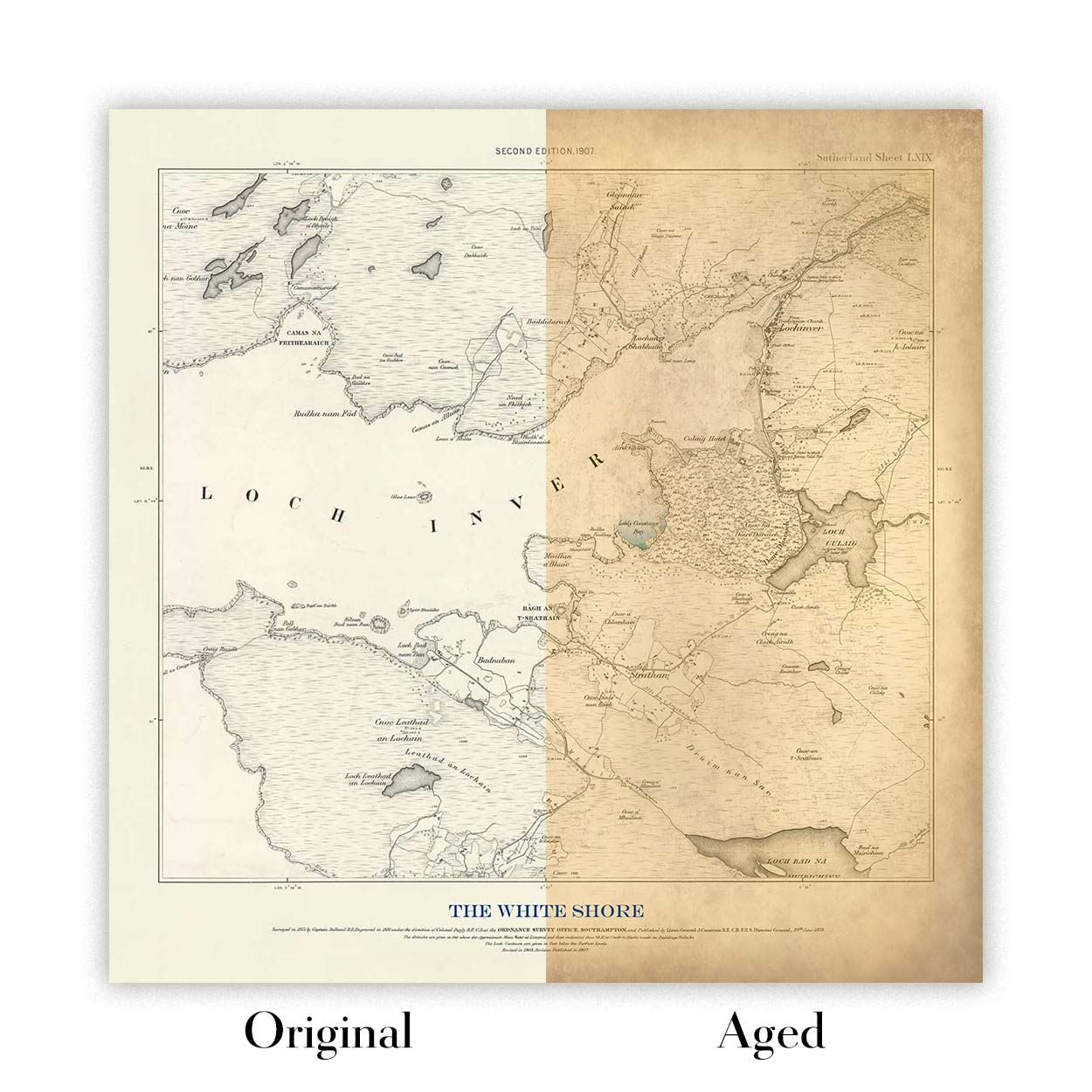
Vieillissement de la carte
Au fil des ans, des clients m'ont demandé des centaines de fois s'ils pouvaient acheter une carte qui semble uniforme. plus vieux.
Eh bien, vous pouvez désormais le faire en sélectionnant Aged avant d'ajouter une carte à votre panier.
Toutes les photos de produits que vous voyez sur cette page montrent la carte dans sa forme originale. Voilà à quoi ressemble la carte aujourd'hui.
Si vous sélectionnez Vieilli, je vieillirai votre carte à la main, en utilisant un processus spécial et unique développé au cours d'années d'étude de cartes anciennes, de discussions avec des chercheurs pour comprendre la chimie du vieillissement du papier, et bien sûr... beaucoup de pratique !
Si vous n'êtes pas sûr, respectez la couleur originale de la carte. Si vous voulez quelque chose d'un peu plus sombre et plus vieux à la recherche, optez pour Aged.
Nous restaurons et produisons des cartes et des tirages d’art depuis 1984, et nous garantissons chaque pièce.
Chaque commande est couverte par notre garantie de 10 ans et notre garantie de livraison sans dommage. Si votre pièce arrive endommagée, nous la remplacerons ou la referons gratuitement. Si quoi que ce soit d’autre ne vous donne pas entière satisfaction, contactez notre équipe d’atelier et nous y remédierons rapidement.
Consultez notre politique de retours et de remboursement pour plus de détails.
Ou lancez une recherche dans la boutique.


