










Fuji from Surugadai in Edo by Katsushika Hokusai, 1760
Authentische Kunstwerke
Die von uns gedruckten Kunstwerke werden getreu nach der Originalvorlage restauriert – in der Regel aus einem Museum, einer Bibliothek oder einer privaten Sammlung. Wir ersetzen, zeichnen nicht neu und erfinden das Werk des Künstlers niemals mithilfe generativer KI.
Weihnachtslieferung & Geschenke

Direkt an die beschenkte Person senden
Fügen Sie in Ihrem Warenkorb eine Geschenknachricht hinzu und geben Sie dann an der Kasse die Lieferadresse der Empfängerin oder des Empfängers ein. Wir drucken Ihre Nachricht auf eine Karte. Dem Paket werden keine Preise beigefügt.
Lieferzeit
Die Standardlieferung ist weltweit kostenlos und dauert in der Regel etwa 3 Werktage. Sie senden ein Geschenk ins Ausland? Wir fertigen die meisten Bestellungen vor Ort, im Land der Empfängerin oder des Empfängers.
Bitte planen Sie bei personalisierten Bestellungen zusätzliche Zeit für Gestaltung und Druckfreigabe ein. Lieferdetails ansehen.
Rücksendungen: Standardbestellungen können innerhalb von 90 Tagen nach Lieferung zurückgegeben oder umgetauscht werden. Personalisierte und individuell angefertigte Stücke sind in der Regel von Rückgaben bei Nichtgefallen ausgeschlossen. Unsere Rückgaberichtlinie ansehen.
Black-Friday-Sale
Wählen Sie einen Artikel und erhalten Sie 20 % Rabatt.
Wählen Sie zwei Werke und erhalten Sie 25 % Rabatt auf beide. Sie können Karten und Kunstdrucke beliebig kombinieren.
Es ist kein Code erforderlich. Das Angebot wird automatisch angewendet.
Vollständige Geschäftsbedingungen
Das Sammlerangebot gilt für berechtigte Werke in standardmäßigen Konfigurationen auf Bestellung. Sondergrößen, personalisierte Designs und Auftragsarbeiten sind ausgeschlossen. Produkte mit „personalised“ oder „custom“ im Namen sind in der Regel ausgeschlossen.
Das Angebot wird als zwei separate automatische Rabatte verwaltet: einer für kleinere Formate und einer für größere Formate. Um sich zu qualifizieren, müssen Sie zwei berechtigte Werke innerhalb derselben Formatgruppe kaufen. Karten und Kunstdrucke können innerhalb jeder Gruppe beliebig kombiniert werden.
Zum Beispiel qualifizieren sich zwei berechtigte Drucke im Format A4 oder 8 × 10 Zoll für 25 % Rabatt auf beide. Ein Druck im kleineren Format und ein Werk im größeren Format qualifizieren sich nicht gemeinsam, da Artikel aus unterschiedlichen Formatgruppen nicht kombiniert werden können, um die Anforderung von zwei Artikeln zu erfüllen.
Es ist kein Rabattcode erforderlich. Ein etwaiger qualifizierender Rabatt wird automatisch in Ihrem Warenkorb und an der Kasse angewendet.
Größe wählen
Ausführung wählen


(Mehr Infos)
Geschenkmitteilung & individuelle Ausführung

Wenn Sie eine Geschenkmitteilung oder eine Ausführung (Puzzle, Aluminiumplatte usw.) hinzufügen möchten, die hier nicht verfügbar ist, geben Sie dies bitte in der "Bestellnotiz" beim Checkout an.
Jede Bestellung wird individuell angefertigt. Wenn Sie die Größe leicht anpassen oder auf einem ungewöhnlichen Material drucken lassen möchten, lassen Sie es uns einfach wissen. Wir haben im Laufe der Jahre Tausende von individuellen Bestellungen bearbeitet, daher gibt es (fast) nichts, was wir nicht bewältigen können.
Sie können uns auch kontaktieren, bevor Sie bestellen, wenn Sie möchten!
- Hergestellt in the USA. Sicher geliefert
- Kommt einwandfrei an – oder wir ersetzen es
-
Weihnachtslieferung & Geschenke Weihnachtslieferung & Geschenke
![Ein Beispiel der gedruckten Geschenknachrichtenkarte in voller Größe anzeigen]()
Direkt an die beschenkte Person senden
Fügen Sie in Ihrem Warenkorb eine Geschenknachricht hinzu und geben Sie dann an der Kasse die Lieferadresse der Empfängerin oder des Empfängers ein. Wir drucken Ihre Nachricht auf eine Karte. Dem Paket werden keine Preise beigefügt.
Lieferzeit
Die Standardlieferung ist weltweit kostenlos und dauert in der Regel etwa 3 Werktage. Sie senden ein Geschenk ins Ausland? Wir fertigen die meisten Bestellungen vor Ort, im Land der Empfängerin oder des Empfängers.
Bitte planen Sie bei personalisierten Bestellungen zusätzliche Zeit für Gestaltung und Druckfreigabe ein. Lieferdetails ansehen.
Rücksendungen: Standardbestellungen können innerhalb von 90 Tagen nach Lieferung zurückgegeben oder umgetauscht werden. Personalisierte und individuell angefertigte Stücke sind in der Regel von Rückgaben bei Nichtgefallen ausgeschlossen. Unsere Rückgaberichtlinie ansehen.
- Hilfe bei der Bestellung?
Beliebt bei Sammlern, Designern und Geschenksuchenden
Über 8.000 5-Sterne-Bewertungen


Katsushika Hokusai’s Fuji from Surugadai, in Yedo sets Japan’s defining mountain beyond the varied terrain and buildings of Edo, the city now...
WeiterlesenKatsushika Hokusai’s Fuji from Surugadai, in Yedo sets Japan’s defining mountain beyond the varied terrain and buildings of Edo, the city now known as Tokyo. Rather than isolating Mount Fuji as a remote natural wonder, Hokusai allows it to emerge from a landscape alive with human movement: figures travel across the sloping foreground, foliage presses into the upper edge, and a partially seen roof anchors the lower right. The mountain’s pale, measured silhouette provides a distant stillness against this busy, asymmetrical arrangement.
Hokusai (1760–1849) returned to Mount Fuji throughout his long career, most memorably in the celebrated series Thirty-six Views of Mount Fuji, to which this design belongs. Such views brought together two subjects central to late Edo-period visual culture: the recognisable life of the capital and a mountain invested with profound spiritual and geographical significance. Woodblock printing made these landscapes available to a broad urban audience, while Hokusai’s inventive compositions transformed familiar places into exercises in scale, movement and graphic structure.
A closer look
The foreground is organised around a rising path and the small figures making their way across it. Among them are carriers with baskets or loads, their compact forms picked out against darker greens and earthy browns. One pale-clothed figure is especially conspicuous, acting almost like a visual marker within the densely coloured lower half of the scene. Clothing patterns and fine contours individualise the travellers without distracting from the larger rhythm of the landscape.
Above them, clustered foliage forms a weighty frame at the upper left. Individual leaves are suggested through brisk, repeated lines, while broader passages of flat green give the trees their graphic force. At the opposite edge, patterned roof tiles introduce another kind of repetition: ordered, architectural and distinctly urban. These details establish Surugadai not as an untouched rural prospect, but as a place where vegetation, buildings and everyday labour coexist.
Mount Fuji appears in the central distance, separated from the foreground by layered hills and softened atmospheric colour. The sky shifts gently between pale yellow and cool blue, allowing the mountain’s outline to remain clear without becoming harsh. This contrast in scale is crucial: the people nearby are animated and particular, while Fuji is reduced to a calm, enduring geometry. The path, intervening land and receding tones guide the eye towards it, so that the mountain seems both far away and structurally essential to the entire composition.
Context and significance
Surugadai was an elevated district of Edo, making it a natural setting for views across the expanding city towards Fuji. Hokusai uses that geography imaginatively, resisting a straightforward panorama in favour of a layered encounter between near and far. His command of the woodblock idiom is evident in the interplay of emphatic contour, flat colour and restrained gradation: depth is created not by conventional Western modelling alone, but through overlapping shapes, tonal intervals and carefully controlled gaps.
The result is characteristic of Hokusai’s finest landscape thinking. Monumental nature is not separated from ordinary existence; it is glimpsed through work, travel, architecture and cultivated ground. Small narrative details reward close attention, yet the composition always returns to the distant mountain, whose quiet profile gives the bustling world of Edo its visual centre.
Choosing the right size and finish
Artwork can feel intimate at smaller sizes and dramatically more architectural at larger ones. Use the room preview, model image and size guide to see how the proportions and scale will work in your space.
If you need an exact size, specialist framing or help planning a larger display, ask our workshop for advice.
The model in the listing images is holding the 18x24in (45x60cm) version of this art print.
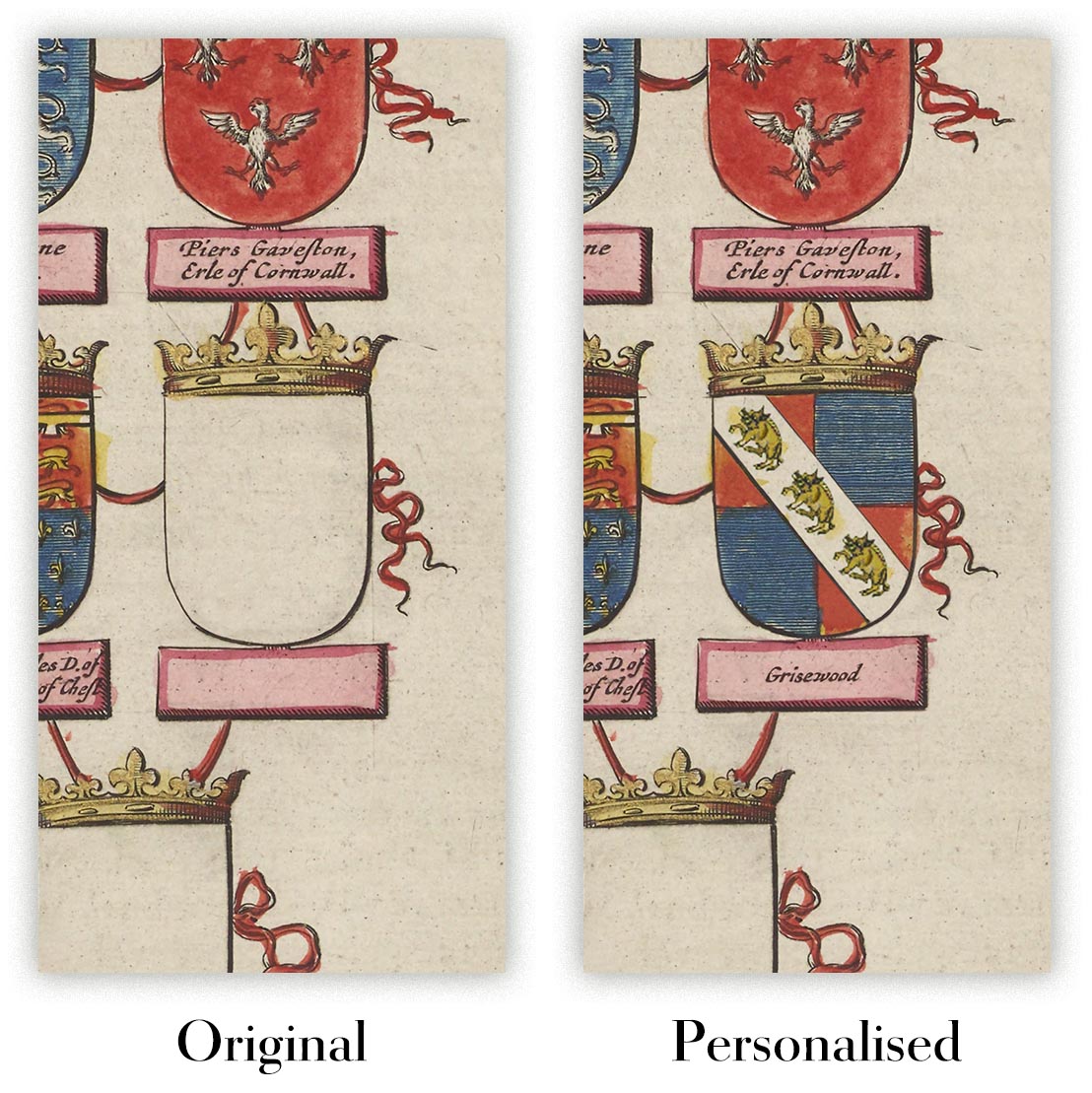
Where personalisation is available, you can add a short title or dedication, or one considered visual detail. See examples of personalised artwork.
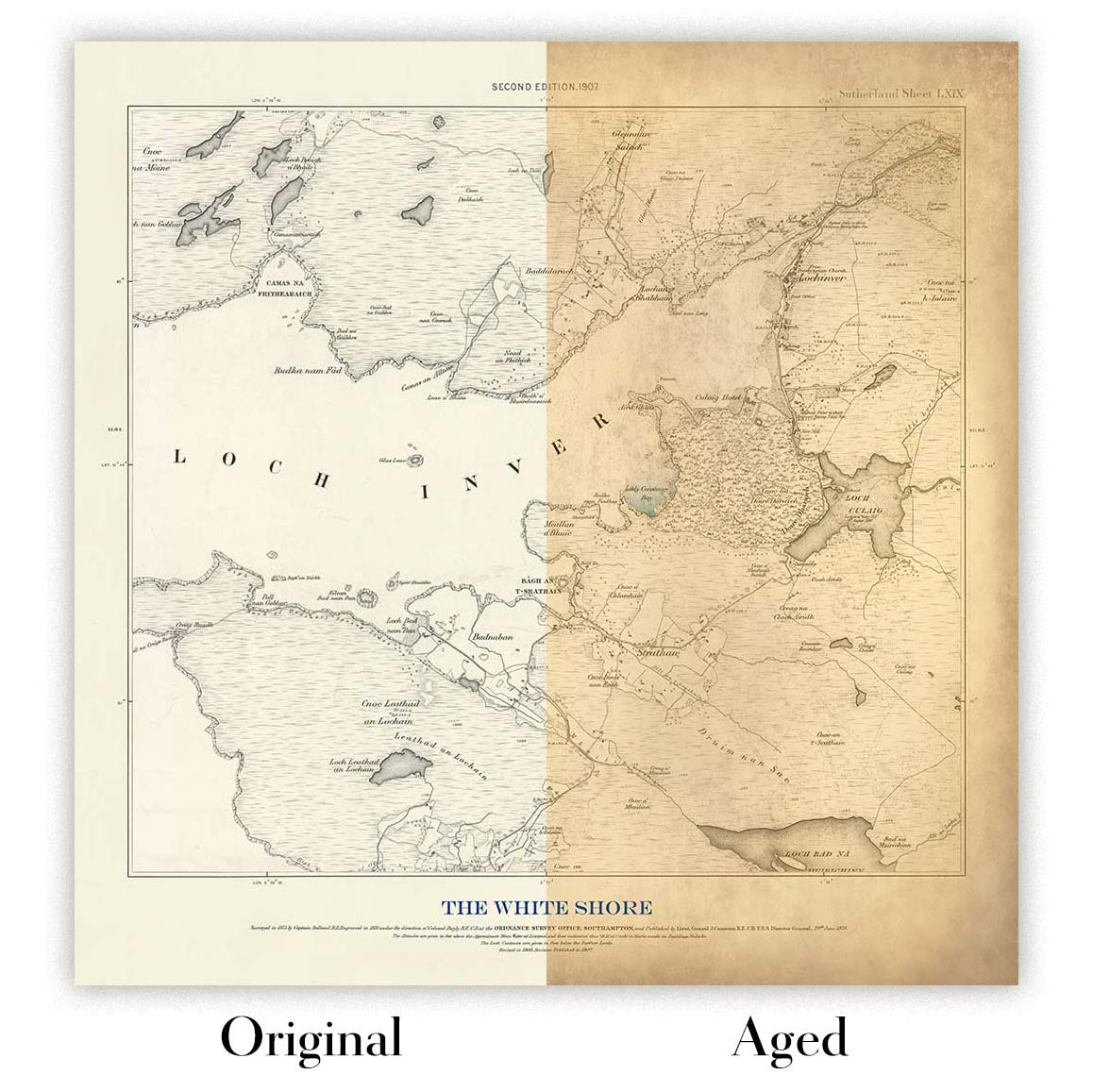
Choose Original to retain the colour and character of the source artwork, or Aged for a warmer, more antique appearance. See examples of our Aged artwork.
Every piece is produced to archival standards using fade-resistant pigment inks on acid-free matte art paper. Choose an art print, framed art print or framed canvas using the finish options above.
Framed art prints use crystal-clear optical acrylic for excellent clarity, lower weight and safer delivery than glass. Each piece arrives professionally framed and ready to hang.
Selected artworks can be produced at statement sizes up to 3 metres (10ft). Custom sizing and specialist framing are also available. If the exact option you need is not listed, contact our workshop.
This artwork is also available as a float framed canvas, sometimes known as a shadow gap framed canvas or canvas floater. The work is printed on artist's cotton canvas and then stretched over a handmade box frame. We then "float" the canvas inside a wooden frame, which is available in a range of colours (black, dark brown, oak, antique gold and white). This is a wonderful way to present an art print without glazing in front. See some examples of float framed canvas art and explore the differences between my different finishes.
Katsushika Hokusai’s Fuji from Surugadai, in Yedo sets Japan’s defining mountain beyond the varied terrain and buildings of Edo, the city now known as Tokyo. Rather than isolating Mount Fuji as a remote natural wonder, Hokusai allows it to emerge from a landscape alive with human movement: figures travel across the sloping foreground, foliage presses into the upper edge, and a partially seen roof anchors the lower right. The mountain’s pale, measured silhouette provides a distant stillness against this busy, asymmetrical arrangement.
Hokusai (1760–1849) returned to Mount Fuji throughout his long career, most memorably in the celebrated series Thirty-six Views of Mount Fuji, to which this design belongs. Such views brought together two subjects central to late Edo-period visual culture: the recognisable life of the capital and a mountain invested with profound spiritual and geographical significance. Woodblock printing made these landscapes available to a broad urban audience, while Hokusai’s inventive compositions transformed familiar places into exercises in scale, movement and graphic structure.
A closer look
The foreground is organised around a rising path and the small figures making their way across it. Among them are carriers with baskets or loads, their compact forms picked out against darker greens and earthy browns. One pale-clothed figure is especially conspicuous, acting almost like a visual marker within the densely coloured lower half of the scene. Clothing patterns and fine contours individualise the travellers without distracting from the larger rhythm of the landscape.
Above them, clustered foliage forms a weighty frame at the upper left. Individual leaves are suggested through brisk, repeated lines, while broader passages of flat green give the trees their graphic force. At the opposite edge, patterned roof tiles introduce another kind of repetition: ordered, architectural and distinctly urban. These details establish Surugadai not as an untouched rural prospect, but as a place where vegetation, buildings and everyday labour coexist.
Mount Fuji appears in the central distance, separated from the foreground by layered hills and softened atmospheric colour. The sky shifts gently between pale yellow and cool blue, allowing the mountain’s outline to remain clear without becoming harsh. This contrast in scale is crucial: the people nearby are animated and particular, while Fuji is reduced to a calm, enduring geometry. The path, intervening land and receding tones guide the eye towards it, so that the mountain seems both far away and structurally essential to the entire composition.
Context and significance
Surugadai was an elevated district of Edo, making it a natural setting for views across the expanding city towards Fuji. Hokusai uses that geography imaginatively, resisting a straightforward panorama in favour of a layered encounter between near and far. His command of the woodblock idiom is evident in the interplay of emphatic contour, flat colour and restrained gradation: depth is created not by conventional Western modelling alone, but through overlapping shapes, tonal intervals and carefully controlled gaps.
The result is characteristic of Hokusai’s finest landscape thinking. Monumental nature is not separated from ordinary existence; it is glimpsed through work, travel, architecture and cultivated ground. Small narrative details reward close attention, yet the composition always returns to the distant mountain, whose quiet profile gives the bustling world of Edo its visual centre.
Choosing the right size and finish
Artwork can feel intimate at smaller sizes and dramatically more architectural at larger ones. Use the room preview, model image and size guide to see how the proportions and scale will work in your space.
If you need an exact size, specialist framing or help planning a larger display, ask our workshop for advice.
The model in the listing images is holding the 18x24in (45x60cm) version of this art print.
Where personalisation is available, you can add a short title or dedication, or one considered visual detail. See examples of personalised artwork.
Choose Original to retain the colour and character of the source artwork, or Aged for a warmer, more antique appearance. See examples of our Aged artwork.
Every piece is produced to archival standards using fade-resistant pigment inks on acid-free matte art paper. Choose an art print, framed art print or framed canvas using the finish options above.
Framed art prints use crystal-clear optical acrylic for excellent clarity, lower weight and safer delivery than glass. Each piece arrives professionally framed and ready to hang.
Selected artworks can be produced at statement sizes up to 3 metres (10ft). Custom sizing and specialist framing are also available. If the exact option you need is not listed, contact our workshop.
This artwork is also available as a float framed canvas, sometimes known as a shadow gap framed canvas or canvas floater. The work is printed on artist's cotton canvas and then stretched over a handmade box frame. We then "float" the canvas inside a wooden frame, which is available in a range of colours (black, dark brown, oak, antique gold and white). This is a wonderful way to present an art print without glazing in front. See some examples of float framed canvas art and explore the differences between my different finishes.
Viele unserer Karten und Kunstdrucke werden als durchdachte Geschenke für Wohnungen, Büros, Arbeitszimmer und bedeutungsvolle Orte ausgewählt.
Wählen Sie eine gerahmte Option als das einfachste, fertig zum Aufhängen gelieferte Geschenk, oder entscheiden Sie sich für einen ungerahmten Druck, wenn der Empfänger seinen eigenen Rahmen lieber selbst auswählen möchte.
Wir fertigen Bestellungen lokal in 23 Ländern weltweit, sodass Geschenke oft in der Nähe des Empfängers produziert werden können. Das trägt dazu bei, dass sie schneller ankommen, sicherer transportiert werden und Überraschungen durch Zoll oder Einfuhrabgaben vermieden werden.
- Wir können direkt an den Empfänger liefern
- Gerahmte Werke werden fertig zum Aufhängen geliefert
- Ungerahmte Drucke werden sorgfältig in einer stabilen Schutzhülle versandt
- Nahezu jede Bestellung wird lokal gefertigt – für schnelleres und sichereres Schenken
- 90 Tage Rückgaberecht geben dem Empfänger Zeit für seine Entscheidung
Wenn Sie nicht sicher sind, was Sie wählen sollen, kontaktieren Sie uns bitte. Wir helfen Ihnen gern dabei, die passende Karte, Größe, Ausführung oder Lieferoption auszuwählen.
Für die meisten Bestellungen beträgt die Lieferzeit etwa 3 Werktage. Personalisierte und maßgeschneiderte Produkte benötigen länger, da ich die Personalisierung durchführen und sie Ihnen zur Genehmigung zusenden muss, was normalerweise 1 oder 2 Tage dauert.
Bitte beachten Sie, dass sehr große gerahmte Bestellungen in der Regel länger für die Herstellung und Lieferung benötigen.
Wenn Sie möchten, dass Ihre Bestellung bis zu einem bestimmten Datum ankommt, bitte kontaktieren Sie mich, bevor Sie bestellen, damit wir den besten Weg finden können, um sicherzustellen, dass Sie Ihre Bestellung rechtzeitig erhalten.
Ich drucke und rahme Karten und Kunstwerke in 23 Ländern weltweit. Das bedeutet, dass Ihre Bestellung lokal gefertigt wird, was die Lieferzeit verkürzt und sicherstellt, dass sie während der Lieferung nicht beschädigt wird. Sie zahlen nie Zoll oder Einfuhrgebühren, und wir stoßen weniger CO2 in die Luft aus.
Alle meine Karten und Kunstdrucke sind gut verpackt und werden in einem robusten Rohr versendet, wenn sie ungerahmt sind, oder von Schaum umgeben, wenn sie gerahmt sind.
Ich versuche, alle Bestellungen innerhalb von 1 oder 2 Tagen nach Erhalt Ihrer Bestellung zu versenden, obwohl einige Produkte (wie Gesichtsmasken, Tassen und Tragetaschen) länger zur Herstellung benötigen können.
Wenn Sie Express-Lieferung an der Kasse auswählen, priorisieren wir Ihre Bestellung und versenden sie per 1-Tages-Kurier (Fedex, DHL, UPS, Parcelforce).
Nächster Tag Lieferung ist auch in einigen Ländern verfügbar (USA, UK, Singapur, VAE), aber bitte versuchen Sie, früh am Tag zu bestellen, damit wir es rechtzeitig versenden können.
Lesen Sie meinen vollständigen Leitfaden zur Lieferung und lokalen Produktion
Mein Standardrahmen ist ein Galerie-Stil-Rahmen aus schwarzem Eschenholz. Er ist einfach und sieht ziemlich modern aus. Mein Standardrahmen ist etwa 20 mm (0,8 Zoll) breit.
Ich verwende super-klares Acryl (Plexiglas/Acrylt) für das Glas des Rahmens. Es ist leichter und sicherer als Glas – und es sieht besser aus, da die Reflexion geringer ist.
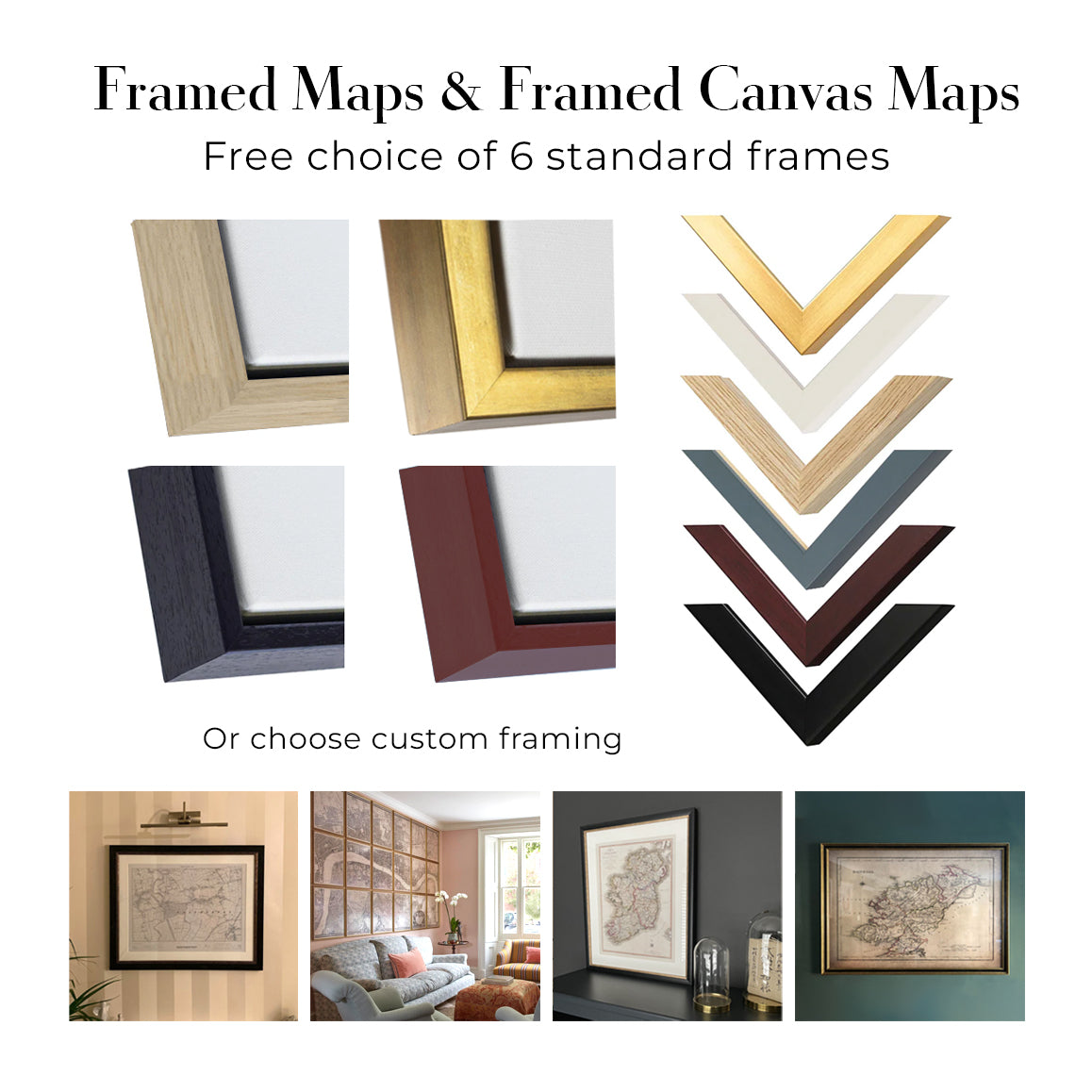
Sechs Standardrahmenfarben sind kostenlos erhältlich (schwarz, dunkelbraun, dunkelgrau, Eiche, weiß und antikgold).
Die meisten Karten, Kunstwerke und Illustrationen sind auch als gerahmte Leinwand erhältlich. Wir verwenden matte (nicht glänzende) Baumwollleinwand, spannen sie über einen nachhaltig beschafften Buchenrahmen und 'schweben' dann das Stück innerhalb eines Holzrahmens. Das Endergebnis ist ziemlich schön, und es gibt keine Verglasung, die im Weg ist.
Alle Rahmen werden "bereit zum Aufhängen" geliefert, entweder mit einer Schnur oder Halterungen auf der Rückseite. Sehr große Rahmen haben schwere Aufhängeplatten und/oder eine Montageschiene. Wenn Sie Fragen haben, können Sie bitte Kontakt aufnehmen.
Sehen Sie sich einige Beispiele meiner gerahmten Karten und gerahmten Leinwandkarten an.
Alternativ kann ich auch alte Karten und Kunstwerke auf Leinwand, Schaumstoffplatten, Baumwollrag und andere Materialien liefern.
Wenn Sie Ihre Karte oder Ihr Kunstwerk selbst rahmen möchten, lesen Sie bitte zuerst meinen Größenleitfaden.
Wir arbeiten mit Innenarchitekten, Unternehmen aus dem Gastgewerbe, Immobilienfachleuten, Büros und Firmenkunden an Einzelstücken sowie an größeren, abgestimmten Projekten.
Dieses Kunstwerk kann an eine bestimmte Wand, einen Raum oder ein Projekt angepasst werden, und unsere Werkstatt unterstützt Sie dabei, Maße, Material und Rahmung vor der Produktion abzustimmen.
- Exakte, übergroße und maßgefertigte Abmessungen
- Individuelle Rahmung, Kaschierung und alternative Materialien
- Abgestimmte Werke für mehrere Räume oder Standorte
- Personalisierung des Kunstwerks zur Anpassung von Farbe und Stil
- Beratung zu Kunstwerk und Rahmung durch unsere Werkstatt
- Lokale Produktion für Projekte weltweit
Besprechen Sie dieses Werk mit unserem Trade & Projects Team
Jeder restaurierte Kunstdruck beginnt mit dem Originalwerk des Künstlers – niemals mit einem KI-generierten Ersatz.
Unser Londoner Studio arbeitet mit sorgfältig ausgewähltem Ausgangsmaterial aus Museen, Bibliotheken, Archiven und privaten Sammlungen. Wir restaurieren altersbedingte Schäden, verblasste Farben und unvollkommene Reproduktionen, während wir die Komposition, den Pinselstrich, die Linienführung, die Textur und den zeittypischen Charakter des Künstlers bewahren.
Wir verwenden keine generative KI, um das Kunstwerk neu zu zeichnen, neu zu interpretieren oder zu erfinden. Digitale Restaurierung dient ausschließlich dazu, das Originalwerk so originalgetreu wie möglich wiederherzustellen und zu reproduzieren.
Sobald die Restaurierung abgeschlossen ist, wird das Masterkunstwerk für die von Ihnen gewählte Größe und Ausführung vorbereitet. Anschließend wird Ihr Stück gedruckt und, sofern ausgewählt, in der Nähe des Lieferorts gerahmt.
Unsere Giclée-Kunstdrucke verwenden säurefreies 200-g/m²-Archiv-Mattpapier und lichtechte Pigmenttinten für ein reichhaltiges Finish in Museumsqualität. Gerahmte Kunstdrucke verwenden kristallklares optisches Acryl und werden hängefertig geliefert.
Gerahmte Leinwand und Sonderausgaben auf Baumwoll-Künstlerpapier sind ebenfalls erhältlich. Erfahren Sie mehr über unsere Materialien und Ausführungen.
Seit 1984 restaurieren und fertigen wir Karten und Kunstdrucke an, und wir stehen hinter jedem einzelnen Stück.
Jede Bestellung ist durch unsere 10-Jahres-Garantie und unsere Garantie für beschädigungsfreie Lieferung abgesichert. Sollte Ihr Stück beschädigt bei Ihnen ankommen, ersetzen oder reproduzieren wir es kostenlos. Sollte sonst etwas nicht in Ordnung sein, kontaktieren Sie unser Werkstatt-Team, und wir kümmern uns umgehend darum.
Ausführliche Informationen finden Sie in unseren Rückgabe- und Erstattungsrichtlinien.


